

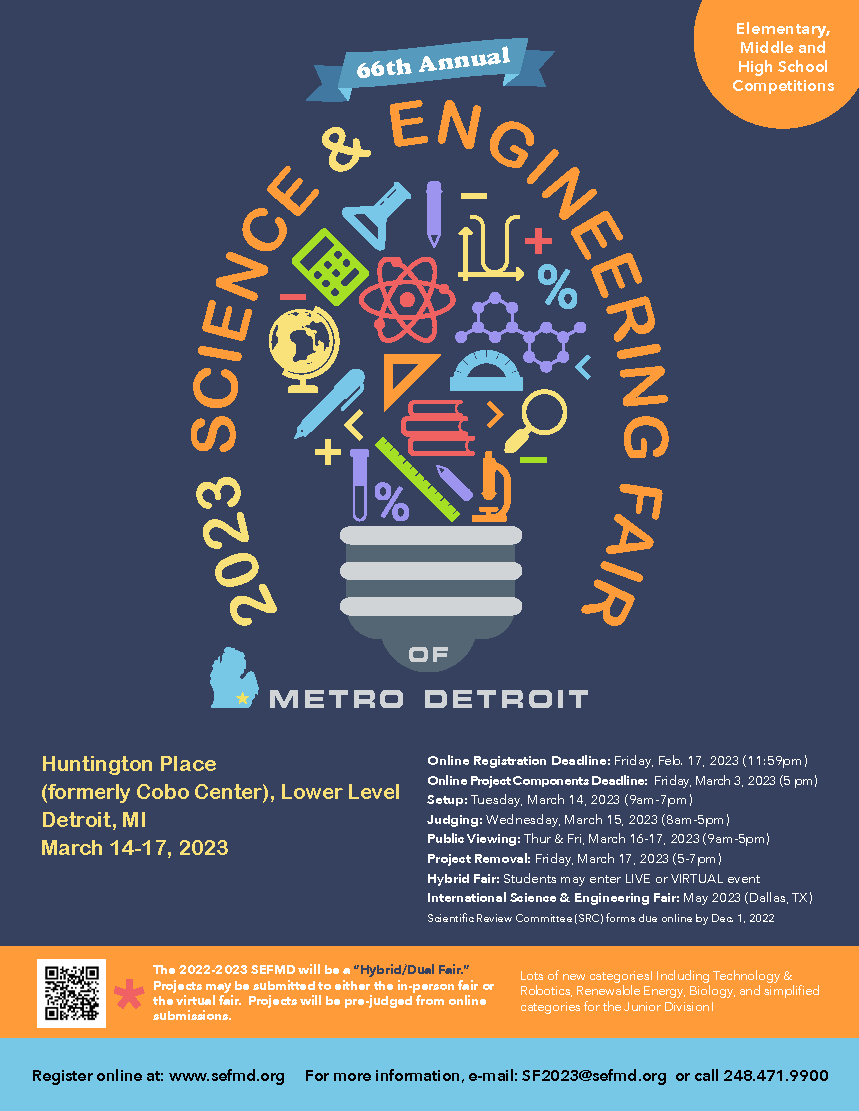
Here’s how to do well at the Science and Engineering Fair of Metro Detroit (SEFMD) and earn your path to the International Science and Engineering Fair (ISEF). Winning here is a real achievement for an aspiring scientist. This guide covers the strategies and tips to maximize your chances.
What is SEFMD?
The Science and Engineering Fair of Metropolitan Detroit, established in September 1956, is a nonprofit that gives students across a seven-county area (Lenawee, Livingston, Macomb, Monroe, Oakland, Washtenaw, and Wayne counties) a chance to develop and exhibit science fair projects.
The competition is split into three groups: Elementary Division (3rd to 5th grade), Junior Division (6th to 8th grade), and Senior Division (9th to 12th grade). Students are judged within their categories. Up to six students (limit of one per school in the senior division) may be selected to compete at ISEF.
SEFMD’s Mission & Values
Mission
Create student excitement for STEM (Science, Technology, Engineering, and Mathematics), inspire interest in scientific subjects and research, develop respect for the scientific method, encourage personal growth, provide recognition for student research, and broaden career opportunities across Metropolitan Detroit and the region.
Values – S.E.A.R.C.H.
- Scientific Method: expose students to the scientific method and how to apply it rigorously to their interests and studies.
- Empowering Experience: give students a chance to grow into STEM professionals by conceptualizing, executing, managing, and presenting their own project.
- Access for All: provide opportunity for interested students, regardless of background.
- Recognition: provide knowledgeable reviews of project content and effort, and recognize student achievement.
- Creativity & Confidence: build and support these core traits in students.
- Highest Integrity and Ethical Behavior: help students practice the highest standards of scientific honesty and integrity, and ensure respect for living things.
Categories at SEFMD
SEFMD offers many categories to explore:
- Life Sciences
- Animal Sciences: investigate animal behavior, genetics, and ecology.
- Cellular Studies: explore cellular processes and functions.
- Ecology: examine interactions between organisms and their environment.
- Genetics: investigate heredity and genetic variation.
- Physiology: study bodily functions and systems.
- Behavioral and Social Sciences
- Cognitive Psychology: explore memory, perception, and decision-making.
- Sociology: analyze social interactions and group dynamics.
- Biochemistry
- Medicinal Biochemistry: focus on drug development and interactions.
- Structural Biochemistry: study the three-dimensional structures of biomolecules.
- Earth and Environmental Sciences
- Climate Science: investigate climate change and its effects.
- Water Science: focus on water quality, availability, and conservation.
- Microbiology
- Bacteriology: study bacteria and their roles.
- Virology: investigate viruses and their behavior.
- Physical Sciences
- Biomedical Engineering: apply engineering principles to healthcare.
- Biomedical Devices: design medical devices for innovative treatments.
Winning Tips at SEFMD
1. Use the Resources from the SEFMD Website
Project Guidelines
High School Projects (9th to 12th grade)
Training Videos
Browse the full list of training videos covering every part of the science fair.
Project Ideas
Find resources to help you come up with a research topic.
Display and Safety
2. Choose a Strong Research Idea
Pick a topic you’re genuinely passionate about. Your project should be original, address a real-world problem, and show your scientific thinking.
Think about current global challenges, gaps in existing research, or new solutions to common problems. Once you have a rough idea, refine it with thorough background research to confirm it’s both novel and feasible.
Developing a strong research idea is hard, but it doesn’t have to be. In this video, Rishab walks you through how to find a good STEM project idea:
3. Prepare a Stellar Presentation
Your presentation is where it comes together. Build a well-organized display board that clearly communicates your research question, methodology, results, and conclusion.
Practice your oral presentation thoroughly:
- Be clear and concise
- Show enthusiasm for your project
- Anticipate likely questions and prepare answers
- Use visual aids effectively
For the best guide on making a science fair poster that impresses judges, watch this video from Rishab Jain, Harvard student and ISEF winner.
4. Conduct Thorough Research

Solid research is the backbone of any winning project. Here’s how to do it well:
- Literature review: start with a thorough review of existing studies to understand your topic’s context.
- Reputable sources: rely on scientific journals, academic books, and trusted online resources.
- Data collection: use reliable, valid methods and gather enough data to support your conclusions.
- Analysis: analyze your data with appropriate statistical or qualitative methods, and be ready to explain your analysis clearly.
Mastering the Scientific Method (or Engineering Design Process)
SEFMD values a rigorous approach. Follow these steps to keep your project on track.
Scientific Method
- Question: identify a problem that intrigues you.
- Research: investigate existing knowledge on the topic.
- Hypothesis: form a testable prediction.
- Experiment: test your hypothesis and collect data.
- Analyze: interpret your data and see if it supports your hypothesis.
- Conclusion: draw conclusions from your findings.
Engineering Design Process
- Define the problem: identify a need or challenge.
- Research and design: explore possible solutions and design a prototype.
- Test and evaluate: assess your prototype and improve it.
- Communicate: document and present your findings clearly.
5. Seek Mentorship
A mentor offers valuable guidance. They can help you refine your research question, troubleshoot experiments, and prepare your presentation. The right mentor can be a game-changer thanks to their experience.
A mentorship program like ScienceFair.io’s A-Z Science Fair Program connects you with expert guidance to maximize your chances of winning.
Conclusion
Winning SEFMD takes dedication, thorough research, and effective presentation skills. Follow these guidelines and put in consistent effort, and you’ll significantly improve your chances. Remember, the journey of scientific discovery is as valuable as the destination.
Good luck!


Leave a Reply